Foot surgery in Alicante: minimally invasive surgery technique (percutaneous)
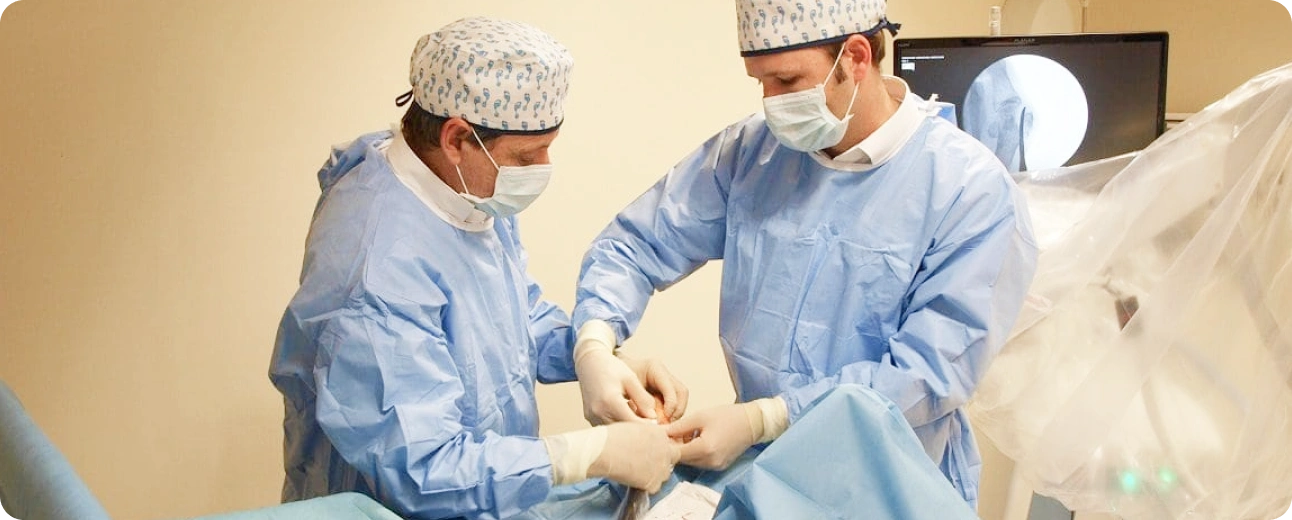
At Clínica San Román we have been dedicated to foot surgery since 1979. We are European pioneers in minimally invasive surgery (MIS) or percutaneous surgery, a technique that corrects foot deformities through millimeter incisions, under local anesthesia and on an outpatient basis: most patients walk out of the operating room the same day.
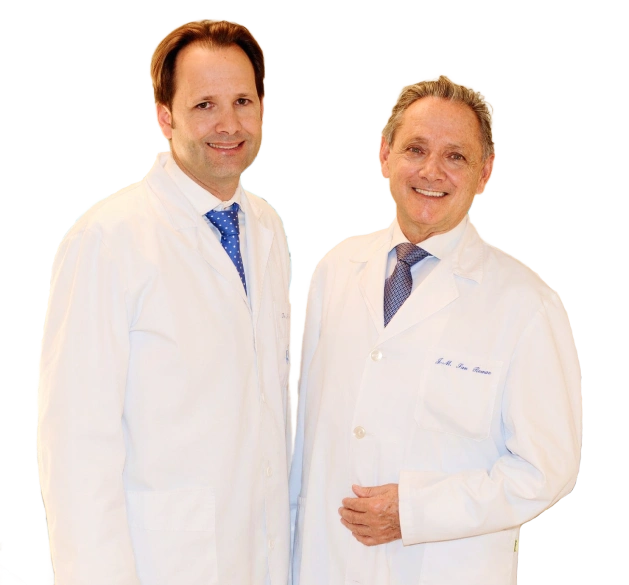
Specialists since 1979
A family saga dedicated to footwear since 1979.
European pioneers in MIS
ABMSP certification (MIS23BE03) in minimally invasive surgery of the foot.
Certified operating room
Health center nº 5357 of the Registry of the Valencian Community.
4.8/5 on Google
Over 200 verified patient reviews.
What is minimally invasive surgery of the foot?
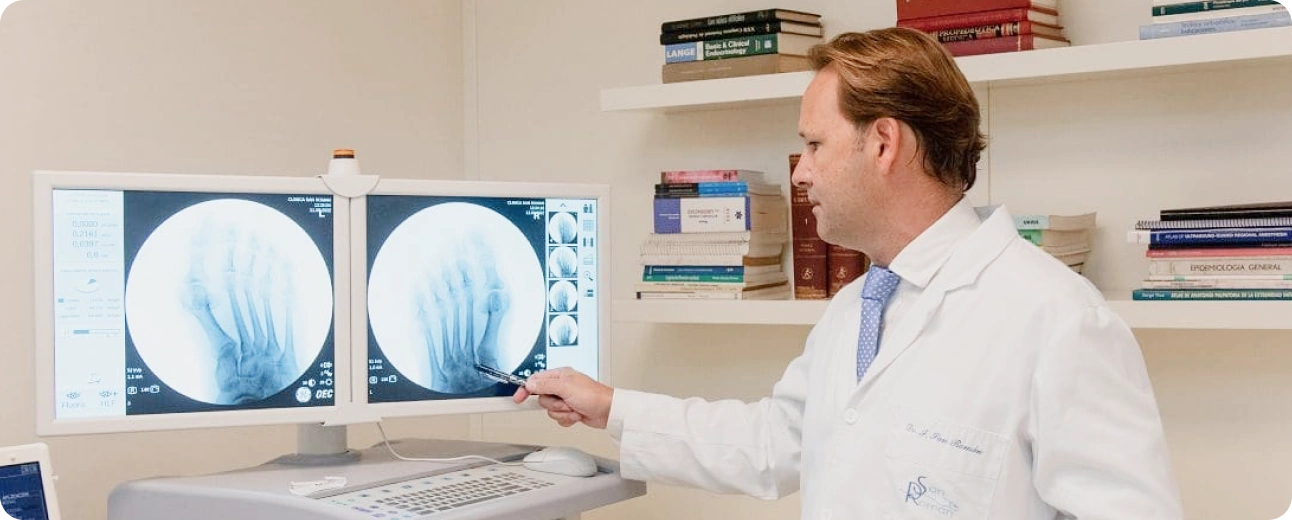
Minimally invasive surgery (MIS), also called percutaneous surgery, makes it possible to treat foot deformities and pathologies through incisions of just 2 to 3 millimeters. Instead of opening the area, the surgeon works on the bone and soft tissues with micro-mills and specific instruments, guided at all times by a fluoroscope (real-time radiology). No laser is used.
This way of operating reduces aggression to the tissues and, compared to traditional open surgery, results in less postoperative pain, faster recovery and almost imperceptible scars. It is a demanding technique that requires experience and specific training of the surgeon, which is why the experience of the team is decisive.
MIS surgery versus traditional open surgery
| Criteria | MIS surgery (percutaneous) | Traditional open surgery |
|---|---|---|
| Incisions | 2-3 mm | Several centimeters |
| Anesthesia | Local, ambulatory | Local/regional or general |
| Income | No: you walk out the same day | Increased rest / sometimes admission |
| Postoperative pain | Usually mild | Usually larger |
| Scar | Minimal, almost imperceptible | More visible |
| Recovery | Faster | Longer |
The most recent systematic reviews comparing both techniques in the bunion describe high patient satisfaction, faster recovery and fewer complications with the minimally invasive approach, with better results in mild and moderate deformities.
Advantages of minimally invasive surgery
Millimeter incisions
Cuts of 2-3 mm leaving barely visible scars.
Local anesthesia
Outpatient procedure, without admission or general anesthesia.
Walking out
You support the foot the same day with a post-surgical shoe.
Less pain
More comfortable and faster recovery than open surgery.
Reduced risk of infection
As the exposed area is reduced during the procedure.
Suitable for more patients
In many cases valid for people who have already undergone surgery or for the elderly, depending on the assessment.
What foot pathologies do we operate on?
The percutaneous approach can treat a wide range of forefoot and foot pathologies. These are some of the most frequent:
- Bunions (hallux valgus): correction of the deviation of the big toe, the most common intervention.
- Claw toes and hammer toes: rectification of deformities of the lesser toes.
- Metatarsalgia: relief of pain in the anterior area of the sole of the foot.
- Hallux rigidus (arthrosis of the big toe) and tailor’s bunion (quintus varus).
- Plantar fasciitis, plantar fasciitis and heel spur resistant to conservative treatment.
- Freiberg’s disease and Haglund’s deformity.
Not all cases are candidates for the percutaneous approach: the indication and the specific technique are decided after an individual assessment with radiological study.
How the process works, step by step
- Evaluation and radiological study. We study your foot, confirm the diagnosis and check if you are a candidate for the technique.
- Personalized planning. We design the intervention according to your deformity, your activity and your objectives.
- Outpatient intervention. With local anesthesia and millimetric incisions; you walk out the same day with your post-surgical shoe.
- Postoperative and revisions. Special bandage, first check-up after one week and changes every 2 weeks until discharge.
- Discharge and follow-up. Progressive return to your normal life and subsequent follow-up throughout the year.
Watch the technique in video
The postoperative period: the special bandage of Clínica San Román
After surgery we apply our own functional bandage that maintains the correction and protects the foot, together with a post-surgical shoe that allows walking from the first moment. It is important to keep the bandage dry: we provide a special cover/boot that seals the ankle so that you can shower with peace of mind.
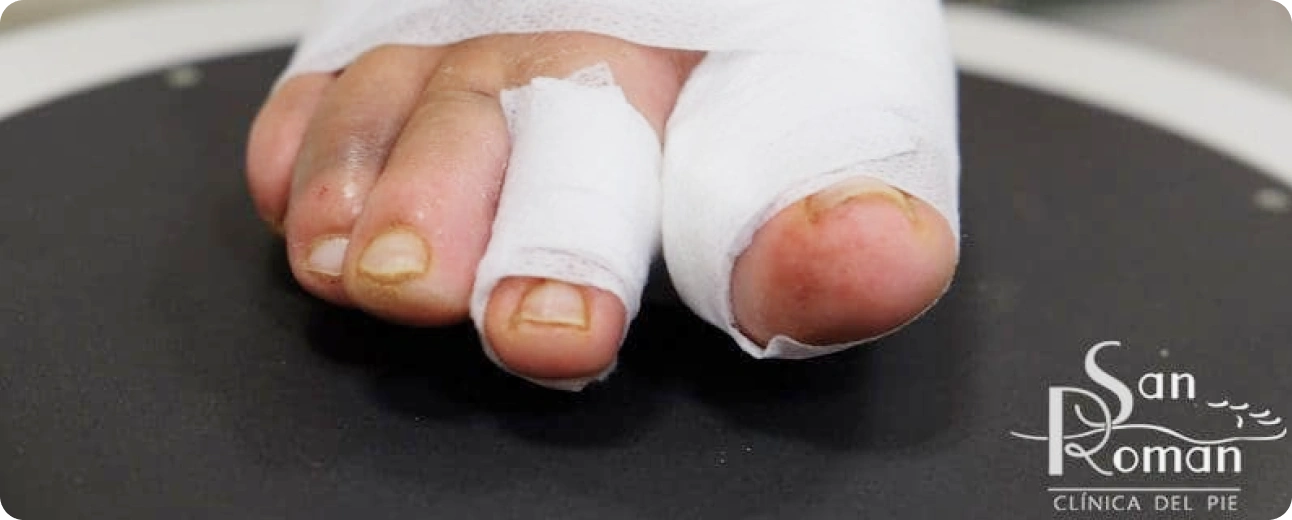
24-hour accompaniment. During the postoperative period we offer 24-hour contact to resolve any doubt or incident, because peace of mind is also part of the recovery process.
We perform a first check-up every week and, afterwards, check-ups every 2 weeks to change the bandage and control the evolution until the patient is discharged. During this period we prescribe the necessary medication and resolve any incident.
Recovery: when do I return to my normal life?
Return to work is gradual. Office tasks can be resumed practically from the first few days, while jobs that require a lot of standing or exertion require a little more time. The changeover to normal footwear usually takes place after about 40 days in operations with osteotomy, and earlier (approximately 2 weeks) in surgeries without osteotomy. High heels and narrow toes should be avoided at first. Each evolution is individual.
International patients
We usually receive patients from the Netherlands, Belgium, United Kingdom, Germany and France. In most cases it is enough to stay one week in Alicante, with two visits: the day of surgery and a review after 7 days. We attend in Spanish, English, German, French and Dutch to accompany you in your language during the whole process.
If you live outside Spain, you can send us your tests and consult us the details of your case before traveling, so that you can organize your stay with all the information.
Why choose Clínica San Román
We are a reference clinic in foot surgery, with scientific support and recognition of the main international societies of the specialty:
- ABMSP – American Board of Multiple Specialties in Podiatry (certification MIS23BE03, first in Europe).
- AOFAS – American Orthopaedic Foot & Ankle Society.
- GRECMIP – Study Group and Minimally Invasive Surgery of the Foot.
- The College of Podiatry (UK) and Academy of Ambulatory Foot and Ankle Surgery (Fellow since 1986).
- Family experience since 1979 and average rating of 4.8/5 with over 200 reviews.
Frequently asked questions about foot surgery
What anesthesia is used to operate on the foot?
With local anesthesia and on an outpatient basis. Depending on the intervention, the whole foot is anesthetized (ankle block) or only the toes to be treated, which significantly reduces the risks associated with general anesthesia.
Will I walk out after the operation?
Yes, a functional bandage and a post-surgical shoe are placed to support the foot and allow the patient to walk out the same day, without hospitalization.
Is foot surgery painful?
No pain is felt during the operation thanks to the local anesthesia. Postoperative pain is usually mild and much less than in open surgery; it is controlled with the usual medication when necessary.
How long does recovery take?
The patient supports the foot from the first day. Discharge is usually around 40 days in operations with osteotomy and earlier in surgeries without osteotomy. The swelling subsides and the foot adapts over 3 to 6 months.
Is there an age limit for surgery?
There is no strict age limit. As it is performed under local anesthesia and on an outpatient basis, it is a valid option for many older patients or patients with other conditions, always after an individual assessment of health status and circulation.
Are there risks involved in foot surgery?
Like all surgery, it is not free of risks. The literature describes, in a minority percentage, the possibility of recurrence, joint stiffness, delayed consolidation or infection. The percutaneous approach reduces tissue trauma. We explain the specific risks in each case in the previous assessment.
I live in another country, can I have surgery in Alicante?
Yes, it is usually enough to stay one week in Alicante, with two visits (the day of surgery and a check-up after 7 days). We attend in Spanish, English, German, French and Dutch.
Can bunions re-form after surgery?
As in any surgical technique, there is a possibility of recurrence. The recurrence of a bunion depends on the anatomy of the foot, the surgical procedure and the subsequent care, not on the percutaneous approach itself. The previous evaluation helps to estimate the prognosis of each case.
Scientific support
Minimally invasive surgery of the foot is increasingly supported in the scientific literature. Systematic reviews and meta-analyses comparing it with open bunion surgery describe faster recovery, high patient satisfaction and fewer complications, especially in mild and moderate deformities. Like any technique, it requires surgeon experience and an individualized indication.
Scientific references
- Minimally invasive surgery for hallux valgus: a systematic review of current surgical techniques. International Orthopaedics. 2019. PMID: 30218181.
- Percutaneous osteotomies in hallux valgus: a systematic review. The Journal of Foot and Ankle Surgery. 2018. PMID: 28870735.
- Minimally invasive versus open distal metatarsal osteotomy for hallux valgus: a systematic review and meta-analysis. Journal of Clinical Orthopaedics and Trauma. 2020. PMID: 32405192.
- Comparative outcomes of minimally invasive versus open hallux valgus surgery: a systematic review and meta-analysis. Surgeries. 2024.
This page is for information purposes only and does not replace the individual clinical assessment. Each case requires a personalized examination.
Request your foot surgery evaluation
If pain or deformity limit your daily life, we help you assess whether minimally invasive surgery is right for you. We study your case and explain options, recovery and expected results, without obligation. Call us at (+34) 965 921 156 or request an appointment.