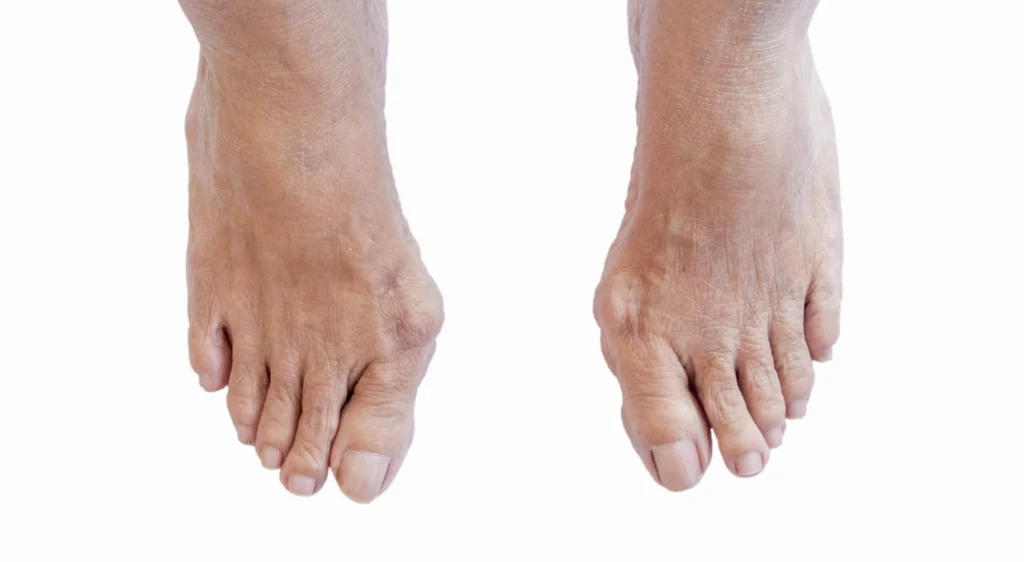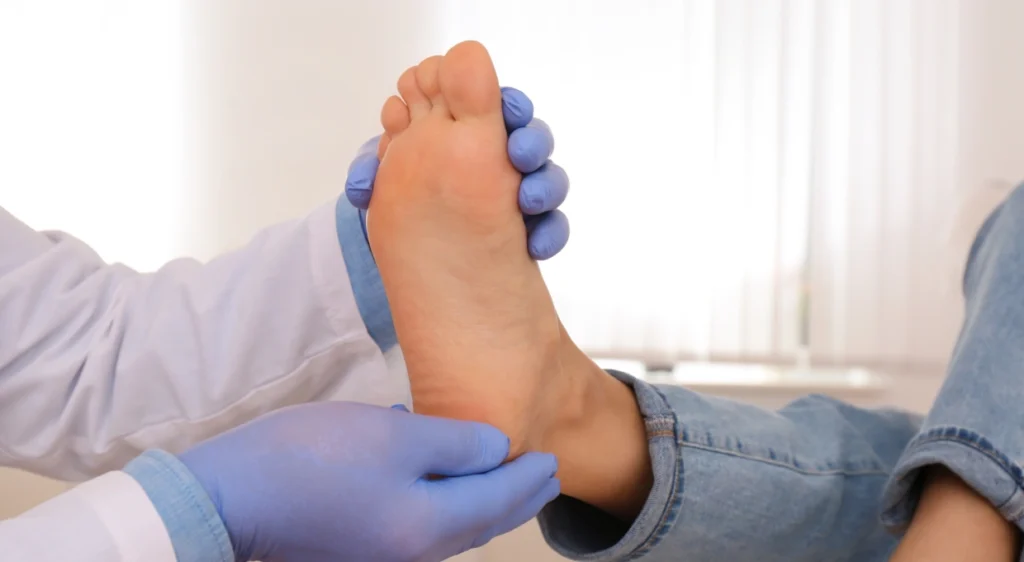

“Will I be awake? Will I hear the saw?”
This is the question that makes people lower their voice in the consulting room. They ask it almost apologetically, as if it were silly. It is not: it is the most common and most legitimate fear surrounding foot surgery.
And there is something curious about it. A great many patients are more reassured by the idea of a general anaesthetic — “just put me under” — than by staying awake. Yet once they walk out of theatre, that judgement flips completely.
We are going to tell you, minute by minute, what local anaesthetic foot surgery really feels like.
Why local anaesthetic foot surgery is the standard here
It is not a matter of convenience or cost. It is a direct consequence of the technique.
Minimal incision surgery (MIS) works through incisions of approximately 1 to 3 mm, with rotary instruments and real-time X-ray control. The foot is not opened, soft tissue is not torn, muscle is not retracted.
Surgical trauma of that scale does not require putting the whole person to sleep. It is enough to block sensation in the foot at ankle level. From then on the foot stops transmitting sensation while you remain conscious, breathing on your own, with your body functioning normally.
This has concrete and quite relevant consequences:
| General anaesthetic | Local anaesthetic (ankle block) | |
|---|---|---|
| Area affected | The whole body | The foot only |
| Pre-operative work-up | More extensive (bloods, anaesthetic review, ECG…) | Less demanding |
| Fasting beforehand | Required | Generally not |
| Nausea, dizziness, confusion on waking | Possible | Not applicable: there is no waking up |
| Hospital stay | Frequent | Day case |
| Afterwards | Recovery room and observation | You walk out on your own two feet |
And there is a benefit almost nobody mentions: local anaesthetic makes the procedure accessible to older people or those with underlying conditions, for whom a general anaesthetic would mean an unnecessary added risk.
What it feels like, step by step
Before going in
You arrive, you change and you lie down. No large intravenous line, no general anaesthetic monitor, no countdown. It feels closer to a consultation than to what most people picture when they think “operating theatre”.
The injection: the only part you feel
Let us be clear, because this is the part that matters: you do feel the moment the anaesthetic goes in. You notice the needle and a sensation of pressure or stinging as the fluid enters. It lasts a short time.
Most patients compare it to the dentist’s anaesthetic: uncomfortable, yes; unbearable, no. And it is, literally, the only thing you will feel of the entire procedure.
Promising you that you will feel nothing would be lying to you. We would rather you arrive knowing exactly what to expect.
The wait: the foot switches off
Then comes a very characteristic phase. The foot starts to feel heavy, warm, “asleep” — that numb sensation everyone knows when a leg goes to sleep. We check that the block is complete before starting.
This is the moment most patients relax: when they confirm for themselves that they genuinely cannot feel their foot.
During the procedure
Here are the three answers everyone is looking for:
- Will I see anything? No. A surgical drape is placed between you and your foot. You will not see the procedure unless you want to and it is possible.
- Will I hear anything? Yes. You hear the motor of the rotary instrument, similar to a dental practice. If that bothers you, you can listen to music with headphones. It is a common request and perfectly compatible.
- Will I feel anything? You may perceive movement or pressure — your foot being moved or held — but you should not feel pain. Pressure and pain travel along different pathways, and the block acts on those that transmit pain.
You can talk during the procedure. You can say if something is uncomfortable. You can ask questions. In fact, that communication is an advantage: you provide information in real time, which is impossible under general anaesthetic.
Afterwards
The functional dressing is applied — not a simple bandage, but the element that holds the correction — along with the rigid-soled post-surgical shoe.
And then comes what surprises people most: you get off the couch and walk out on your own two feet. No recovery room, no dizziness, no waiting for anything to wear off. We cover it in more detail in why walking out on the first day changes everything.
When it wears off: what to expect in the first hours
The block does not last indefinitely. Over the following hours the foot gradually regains sensation, with tingling similar to a leg waking up.
It is normal to feel discomfort in the operated area at that point. The pain relief schedule you are given is designed precisely for that moment, and the general recommendation is not to wait until the discomfort has fully set in before taking the prescribed medication, but to follow the schedule indicated.
Since there is no soft-tissue tearing, post-operative discomfort with the percutaneous technique is considerably lower than with open surgery. We deal with it fully in does bunion surgery really hurt?
If you are someone who gets very anxious
Say so. It is not an aside: it is useful clinical information.
Things that help and that you can ask for without any problem:
- Headphones with your own music or a podcast. This works best against the sound of the instruments.
- Being told what is being done — or exactly the opposite: being told nothing. Both are valid, just tell us which you prefer.
- Bringing someone with you and having somebody waiting for you.
- Mentioning any previous bad experience with anaesthetics or procedures beforehand. It changes how we approach the moment.
The fear of being awake almost always disappears in the first few minutes, when the patient confirms the foot feels nothing. What began as the most dreaded part ends up being, in most cases, the most uneventful.
The same question, answered on video
If hearing it reassures you more than reading it, we explain it here in just over two minutes (in Spanish):
Frequently asked questions
Can I ask to be put fully to sleep?
The percutaneous technique is designed to be performed under local anaesthetic, which is what allows it to be a day case and for you to walk out. If you have a specific reason to consider another option, raise it with the team at the assessment and your case will be reviewed.
Do I have to fast?
It is generally not necessary with a local anaesthetic, but always follow the specific instructions given for your case. You will receive them in writing before the procedure.
Can I drive afterwards?
Do not drive on the day of the procedure. Arrange how you will get home before you come.
What if I feel pain during the operation?
We check that the block is complete before starting, and you are awake and can speak up at any moment. If you were to feel discomfort at any point, the block is reinforced. You do not have to put up with anything.
Is it the same if both feet are operated on?
The block is performed at both ankles. The experience during the procedure is the same. The criteria for the bilateral approach are explained in operating on both feet at once.
Who stands behind this content
Content produced by Clínica San Román, dedicated to percutaneous foot surgery in Alicante since 1979, three generations. Medical team of the clinic:
Dr. José Manuel San Román Pérez — Fundador y Director Médico. Podólogo. Especialista en Cirugía Percutánea del Pie. Nº Colegiado: 2077.
Dr. I. San Román Sirvent — Médico. Especialista en Medicina Familiar y Comunitaria. Board Certified in Minimally Invasive Foot Surgery (USA). Nº Colegiado: 03-0310448-2.
Clínica San Román (Elosnasi, S.L.) · Registered healthcare centre no. 5357, Registro Autonómico de Centros, Servicios y Establecimientos Sanitarios de la Comunitat Valenciana.
Last updated: 31 August 2026.
This article is for information purposes and does not replace an in-person medical assessment. The anaesthetic and pain relief protocol is individualised in each case.
- 📞 Phone: (+34) 965 921 156
- 📧 Email: info@clinicasanroman.com
- 📍 Address: Av. del Doctor Ramón y Cajal 1, 03001 Alicante, Spain