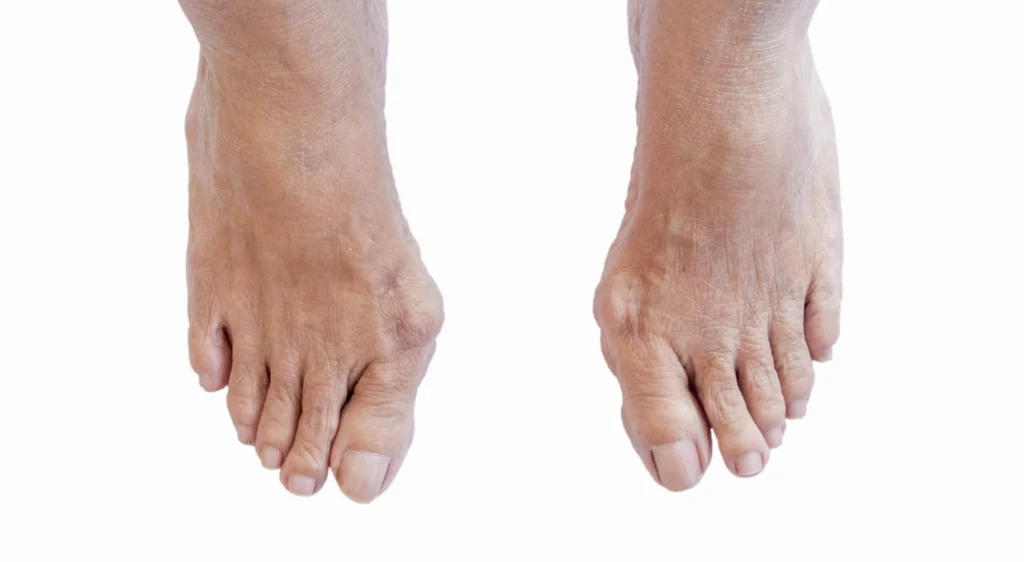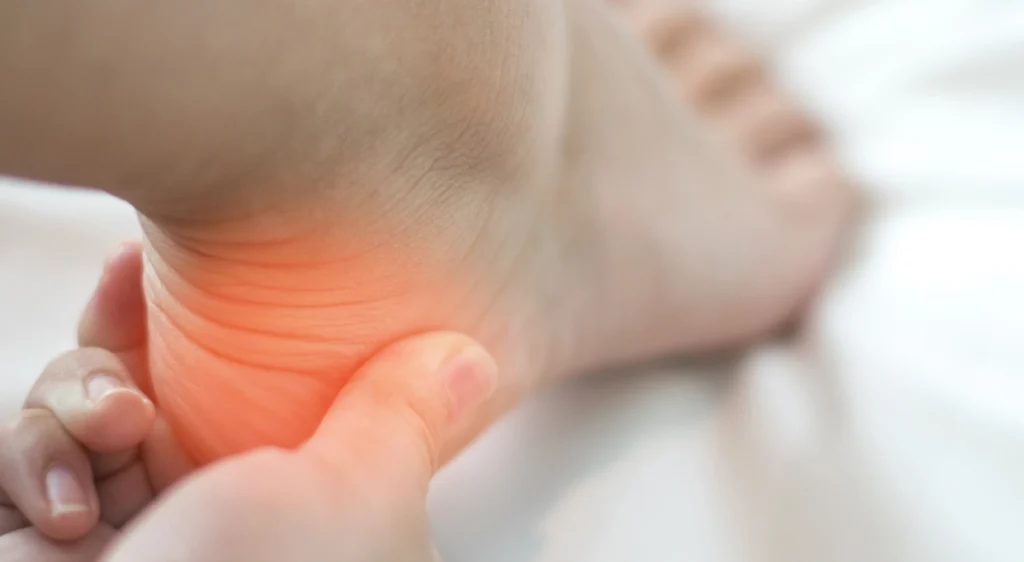

“Back home they told me: one foot first, and the other one in six months.”
We hear this sentence almost every week, and especially from patients coming from the United Kingdom, Ireland, the Netherlands, Belgium and Germany. They arrive assuming that having both feet operated on means two procedures, two periods off work, two recoveries and, with a bit of bad luck, an entire year of their life planned around it.
The surprise is usually twofold: first, that in many cases both feet can indeed be treated in the same procedure; and second, that the reason this is not offered elsewhere is not caution, but surgical technique.
We will explain honestly when both feet bunion surgery at once is possible, including the cases in which we ourselves advise against it.
Why open surgery forces one foot at a time
In traditional open surgery the surgeon needs to see the bone directly. That means incisions of 5 to 10 centimetres, opening the soft tissue and, once the bone has been realigned, placing internal fixation material: screws, plates or wires.
That approach has one direct, unavoidable consequence: the operated foot cannot bear weight. It needs immobilisation and offloading for weeks. And if one foot cannot bear weight, the other has to carry the whole body.
Operating on both at once with that technique would leave the patient with no supporting foot at all: wheelchair, total dependence and a considerably higher risk. So with open surgery, the recommendation to operate one foot at a time is the right one. It is not a limitation of the surgeon: it is a limitation of the method.
What changes with minimal incision surgery
Percutaneous or minimal incision surgery (MIS) starts from a different premise: not opening the foot. We work through millimetric incisions — approximately 1 to 3 mm — with high-precision rotary instruments under fluoroscopic control, that is, real-time X-ray.
Because soft tissue is not torn and the bone is not exposed, three things happen that change everything:
- Surgery is performed under local anaesthetic, through an ankle block. No general anaesthetic, no epidural, and therefore no need to go through their after-effects twice.
- In most cases no screws or plates are used. The bone is stabilised with a specific functional dressing, which is part of the treatment itself.
- Immediate weight-bearing is allowed. The patient walks from day one in a rigid-soled post-surgical shoe.
And here is the key: if both feet can bear weight from day one, the reason for separating them disappears. There is no longer a “healthy” foot that has to carry the other. Both work, both recover.
| Traditional open surgery | MIS technique | |
|---|---|---|
| Incisions | 5 – 10 cm | 1 – 3 mm |
| Anaesthetic | General or epidural | Local (ankle block) |
| Fixation material | Screws, plates or wires | No internal material in most cases |
| Weight-bearing | Offloading for weeks | Immediate, in a post-surgical shoe |
| Both feet | Usually in two stages | Can be considered in the same session |
| Hospital stay | Frequent | Day case |
When we do consider both feet bunion surgery at once
Technically possible does not mean automatic. These are the factors in favour:
- A symmetrical or similar deformity in both feet. This is the most common situation, because hallux valgus has a structural and hereditary component that usually affects both sides.
- Good general health and good circulation in both limbs.
- Being able to take it easy for a few days, keeping the foot elevated when not walking.
- Support at home during the first week. Not essential, but it makes things far easier.
- An adapted environment: few stairs, an accessible bathroom, no need to drive in the first days.
- Travelling from abroad and having good reason to concentrate everything into a single trip.
When we ADVISE AGAINST it
This is the part almost nobody writes, and it is the one that should give you the most confidence. We advise against the bilateral approach when:
- One foot is far more deformed than the other. If one is severe with claw toes and the other has barely started, it makes more sense to resolve the painful one and monitor the other.
- There are circulation or healing problems, or uncontrolled underlying conditions.
- The patient lives alone, with no support, in a home with many stairs. Walking is possible; carrying the shopping up four flights is not reasonable.
- There is a balance problem, dizziness or pre-existing instability.
- The patient cannot slow down. If work or life does not allow a few quiet days, staging the procedures is preferable.
- The patient simply prefers to go step by step. A perfectly valid reason, and one we always respect.
The decision is made at the in-person assessment, not before. And it is made with you, not for you.
One recovery period instead of two
When the bilateral approach is indicated, the advantage is not only convenience. It is arithmetic:
- One preparation (tests, assessment, planning).
- One adaptation period in a post-surgical shoe, instead of repeating it months later.
- One set of arrangements at home and at work.
- Symmetry from the start. This point is underestimated: when only one foot is operated on, you walk for months on two feet that behave differently, and that generates compensation. With the bilateral approach, both feet progress together.
Recovery times are those of the percutaneous technique, and we set them out step by step in recovery after bunion surgery and in the actual recovery timetable for sport.
Especially relevant if you are travelling from abroad
For someone living in Alicante, staging two procedures is an inconvenience. For someone flying in from London, Manchester, Dublin or Amsterdam, it is simply double everything: two flights, two stays, two periods of leave.
That is why the bilateral approach is one of the main reasons international patients choose us. In practice, you arrive the day before surgery and can usually fly home 24 to 48 hours afterwards: in total, 2 to 3 days are normally enough. A check-up at the clinic always takes place before the return flight.
What about your insurance?
Whether treatment abroad is covered depends entirely on your policy and your country. We cannot handle the reimbursement for you, but we can provide the medical documentation insurers usually request: surgical report, post-operative instructions and prescriptions, translated into English, French, German or Dutch.
Our advice: check with your insurer before you travel and tell us which documents they need. Requesting a document afterwards is always harder than being handed the right one at the time. All the practical information is on our international patients page.
The same question, answered on video
This is by far the most watched question on our YouTube channel: more than 31,000 people have searched for exactly this.
Frequently asked questions
Will I be able to walk with both feet operated on?
Yes. Immediate weight-bearing is precisely what makes the bilateral approach possible: you walk from the same day in a rigid-soled post-surgical shoe. That said, we are talking about short, essential journeys during the first days, not normal daily life.
Will I need crutches or a wheelchair?
With the percutaneous technique they are usually not needed. Some patients feel steadier with a walking stick in the first days, particularly after bilateral surgery. It is a comfort choice, not a clinical necessity.
Does it hurt twice as much with two feet?
It does not work that way. Post-operative discomfort with the MIS technique is considerably lower than with open surgery because there is no tissue tearing. Operating on both feet does not multiply that discomfort, although the first days should be planned properly. We cover it fully in does bunion surgery really hurt?
What if I also have claw toes?
Correcting them in the same procedure is considered. In fact, leaving the lesser toes uncorrected is one of the causes of incomplete results.
How do I know if I am a candidate?
It is decided after examination and a weight-bearing X-ray of both feet. Beforehand, photographs and any previous X-rays already allow us to give you an initial orientation, so that you do not travel without a clear picture.
Who stands behind this content
Content produced by Clínica San Román, dedicated to percutaneous foot surgery in Alicante since 1979, three generations. Medical team of the clinic:
Dr. José Manuel San Román Pérez — Fundador y Director Médico. Podólogo. Especialista en Cirugía Percutánea del Pie. Nº Colegiado: 2077.
Dr. I. San Román Sirvent — Médico. Especialista en Medicina Familiar y Comunitaria. Board Certified in Minimally Invasive Foot Surgery (USA). Nº Colegiado: 03-0310448-2.
Clínica San Román (Elosnasi, S.L.) · Registered healthcare centre no. 5357, Registro Autonómico de Centros, Servicios y Establecimientos Sanitarios de la Comunitat Valenciana.
Last updated: 31 August 2026.
This article is for information purposes and does not replace an in-person medical assessment.
- 📞 Phone: (+34) 965 921 156
- 📧 Email: info@clinicasanroman.com
- 📍 Address: Av. del Doctor Ramón y Cajal 1, 03001 Alicante, Spain