
Frequently asked questions about minimally invasive (percutaneous) foot surgery
If you have any doubts about minimally invasive surgery of the foot, its indications, the procedure or postoperative care, here you will find clear, verified and updated answers. At Clínica San Román we have been perfecting this technique since 1979 and we want you to make your decision well informed and with confidence at every step.
About the technique
What is minimally invasive surgery or percutaneous surgery of the foot?
It is a surgical technique that corrects foot deformities and pathologies through incisions of only 2 to 3 millimeters, without opening the area. With specific instruments and radiological control by fluoroscope, the surgeon acts on the bone and soft parts with minimum aggression to the tissues. Compared to traditional open surgery, this translates into less postoperative pain, faster recovery and almost imperceptible scars.
Is minimally invasive surgery of the foot performed with lasers?
No. In the 1980’s the term “laser surgery” became popular to refer to techniques with millimeter incisions, but this is inaccurate. Percutaneous surgery does not use lasers: it uses micro-mills and specific surgical instruments under radiological control.
Where should this type of foot surgery be performed?
Always in an operating room approved for these techniques, with strict control of hygiene and sterility. At Clínica San Román we have our own approved operating room (Health Center No. 5357 of the Registry of the Valencian Community) and we comply with current regulations, including Royal Decree 487/2022 on prevention and control of Legionella.
Indications: for whom
What pathologies can be treated with percutaneous surgery of the foot?
Among the most frequent: bunions (hallux valgus), claw toes or hammer toes, metatarsalgia, Morton’s neuroma, hallux rigidus (arthrosis of the big toe) and heel pathology such as heel spurs or plantar fasciitis. The indication and the specific technique are decided after an individual assessment, since not all cases are candidates for the percutaneous approach.
Who is a good candidate for this surgery?
Patients with painful or gait-limiting deformities that have not improved with conservative treatment (insoles, physiotherapy, medication), without serious circulation problems or uncontrolled systemic diseases. Prior assessment determines the suitability in each case.
Can all bunions be operated on with minimally invasive surgery?
Not always. It depends on the degree and type of deformity and patient characteristics. The scientific literature indicates that the percutaneous approach offers the best results in mild and moderate deformities; in severe cases another technique may be required. The specialist and the patient decide together on the most appropriate treatment.
The intervention
What type of anesthesia is used?
Local anesthesia. Depending on the type of surgery, it may affect the whole foot or only the toes to be operated on, which significantly reduces the risks associated with general anesthesia. In selected cases, sedation may be added.
Is percutaneous surgery of the foot painful?
There is no pain during the operation thanks to the local anesthesia. Postoperative pain is usually mild and considerably less than in open surgery, and is controlled with the usual medication when necessary.
Can I walk out of the operating room?
Yes, it is an outpatient surgery: after the intervention, a functional bandage and a post-surgical shoe are placed, allowing the foot to be supported and to walk out the same day, without the need for hospitalization.
Is it possible to operate on both feet at the same time?
It is possible. For the patient’s comfort we usually operate on consecutive days. It is not recommended to leave more than one day between both feet, since it could alter the gait and generate osteoarticular discomfort due to overload.
Recovery and postoperative period
What is the postoperative period like?
Ambulatory. A special bandage and a post-surgical shoe are applied, and covers are provided so that you can shower without getting the bandage wet. The dressing is changed approximately every 2 weeks and the patient is usually discharged after about 40 days, with a subsequent follow-up every 3 months throughout the year. The patient supports the foot from the first day.
When can I return to work, drive or exercise?
Light activities can be resumed almost immediately; the return to work depends on their intensity. Do not drive while wearing the special bandage. Gentle exercise is usually restarted at 2-3 weeks and impact or jumping exercises at 8 weeks, always depending on the evolution of each case.
How long does it take to see the final results?
The correction is visible from the first moment, but the swelling subsides and the foot adapts to its new position over a period of 3 to 6 months, during which time it continues to improve in appearance and function.
Results, risks and guarantees
What are the results and can the bunions return?
Recent systematic reviews describe high patient satisfaction, faster recovery and fewer complications than open surgery, with good correction especially in mild and moderate deformities. As with any technique, there is a possibility of recurrence: whether a bunion will recur depends on the anatomy of the foot, the surgical procedure and the subsequent care, not on the technique itself. Each case evolves individually.
Is percutaneous surgery of the foot risky?
Like all surgery, it is not free of risks. The literature describes, in a minority of cases, the possibility of recurrence, joint stiffness, delayed consolidation or infection. The percutaneous technique reduces the trauma to the tissues and thus reduces several of these risks. We explain the specific risks in each case in the pre-assessment.
Why Clínica San Román
What differentiates Clínica San Román in foot surgery?
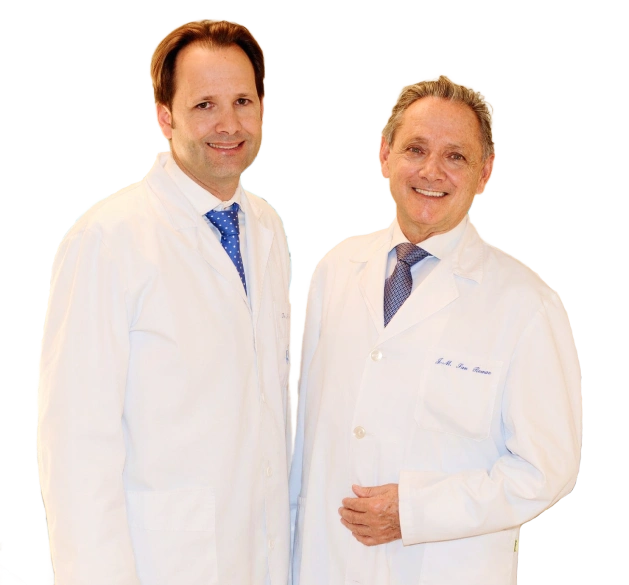
More than 45 years of experience and three generations specialized in the foot; we are European pioneers in minimally invasive surgery (ABMSP certification, MIS23BE03); we have our own certified operating room; we offer multilingual attention (Spanish, English, German, French and Dutch) for the international patient, and a personalized follow-up from beginning to end.
What non-surgical treatments does the clinic perform?
Chiropodology, treatment of papillomas and plantar warts (including Swift microwave technology), orthopodology and custom insoles with static and dynamic gait study, and hyaluronic acid infiltrations in joints, among others.
Scientific support
Our approach is based on current scientific evidence. Systematic reviews and meta-analyses on minimally invasive surgery of the bunion describe, compared to open surgery, a faster recovery, high patient satisfaction and fewer complications, with better results in mild and moderate deformities.
Scientific references
- Minimally invasive surgery for hallux valgus: a systematic review of current surgical techniques. International Orthopaedics. 2019. PMID: 30218181.
- Percutaneous osteotomies in hallux valgus: a systematic review. The Journal of Foot and Ankle Surgery. 2018. PMID: 28870735.
- Minimally invasive versus open distal metatarsal osteotomy for hallux valgus: a systematic review and meta-analysis. Journal of Clinical Orthopaedics and Trauma. 2020. PMID: 32405192.
- Comparative outcomes of minimally invasive versus open hallux valgus surgery: a systematic review and meta-analysis. Surgeries. 2024.
This page is for information purposes only and does not replace the individual clinical assessment. Each case requires a personalized examination.
Can we answer your questions in an appraisal?
Every foot is different. The best way to know if minimally invasive surgery is right for you is a personalized assessment with our team. We will explain options, recovery and expected results, without obligation.