
Patients often come to a podiatrist’s office when foot pain becomes unbearable or when they can no longer walk normally. However, there is an invisible reality that modern medicine has brought to light: the foot is the basis of our kinetic chain. When the structure of the foot fails due to deformities such as bunions (hallux valgus) or claw toes, the entire body pays the consequences.
At Clínica San Román, pioneers in Minimal Incision Surgery (MIS), we approach these pathologies not only as a localized problem, but also as a key element for the joint and postural health of our patients.
The foot as a base: The concept of the kinetic chain.
Imagine your body as a multi-story building. If the foundation is slightly inclined, cracks will eventually appear on the second floor and the roof will eventually give way. In the human body, the foot is that foundation.
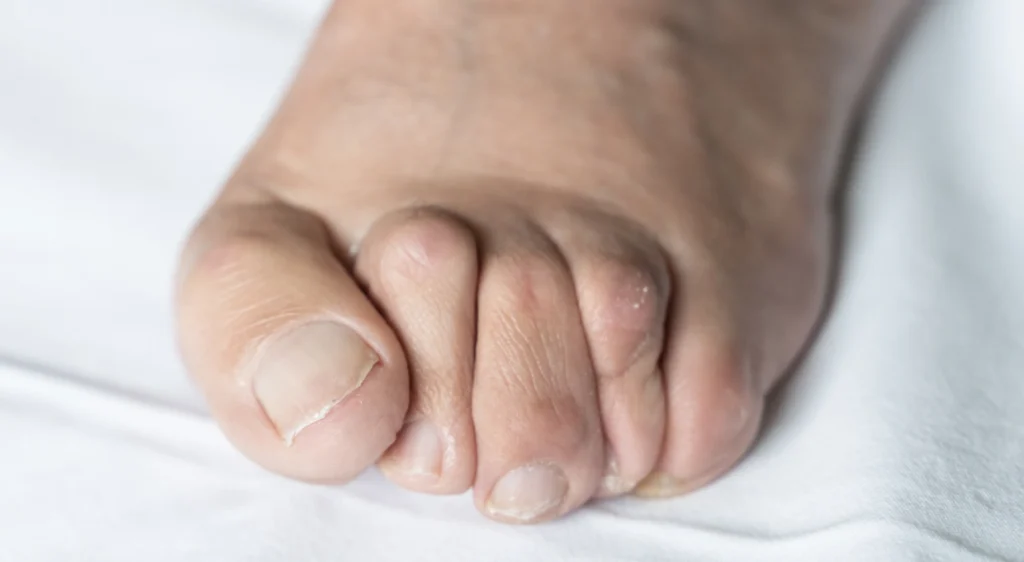
When a patient suffers from bunions, the first metatarsal is deviated, causing the weight of the body to be unevenly distributed during walking. As the primary support fails, the body seeks to “compensate” for this lack of balance, forcing the upper joints to work unnaturally.
🦵 Impact on the knees: Misalignment and wear and tear.
The knee is a joint designed primarily to flex and extend in one plane. When the bunion forces the foot to rotate inward (overpronation), internal rotation of the tibia occurs.
This forced rotation generates mechanical stress on the knee compartments, which can result in:
- Chondromalacia patellae: Wear and tear of the cartilage due to inadequate friction of the patella.
- Premature osteoarthritis: Unequal load distribution accelerates the deterioration of articular cartilage.
- Meniscus and ligament pain: Due to the constant torsion to which they are subjected with each step.
Ignoring a claw toe or bunion is, in many cases, buying a ticket to future knee surgery.
Impact on the back and spine: The origin of low back pain
If the foot steps wrongly and the knee is twisted, the pelvis must tilt to maintain the center of gravity. This pelvic tilt alters the natural curvature of the spine, especially in the lumbar region.
Many patients with chronic low back pain or even sciatica discover that the real origin of their problem lies in poor footing caused by digital deformities. Claw toes, losing their function of “grip” and balance, force the back muscles to make an extra effort to maintain stability, generating contractures and chronic muscle fatigue.

📊 Table: Consequences of lack of treatment.
| Foot deformity | Immediate effect on the footprint | Long-term impact on the body |
| Bunions (Hallux Valgus) | Load axis displacement | Tibial rotation and knee osteoarthritis |
| Claw Fingers | Loss of stability and balance | Lumbar overload and postural fatigue |
| Lack of metatarsal support | Painful calluses (helomas) | Gait disturbance and hip pain |
The ultimate solution: Minimally Incisional Surgery (MIS)
The good news is that correcting the “base” today prevents the wear and tear of the “building” tomorrow. At Clínica San Román, we correct these deformities using the MIS (Minimal Incision Surgery) technique.
Why does the MIS technique protect your overall health?
- Real Biomechanical Correction: We not only eliminate the bulge, we realign the bone structure so that you can walk correctly again.
- Recovery without atrophy: By walking out of the clinic, the muscles and joints do not suffer from the standstill of a postoperative period in bed, avoiding muscle imbalances.
- Chronic Prevention: By restoring foot function, we relieve the knees and back from the immediate compensatory load.
Conclusion: Your body is a unit
Don’t look at your feet in isolation. If you have bunions or claw toes, your body is performing thousands of daily compensations that are exhausting your upper joints. Modern podiatric surgery at Clínica San Román is not just a matter of aesthetics or relieving occasional pain; it is a necessary intervention to preserve the long-term health of your spine and knees.
Professional consultation: A timely biomechanical and radiological assessment can save you years of physical therapy treatments for your back that only address the symptom, but not the cause.